Common OpenSSL Commands with Keys and Certificates
# Generate Private Key and Certificate using RSA 256 encryption (4096-bit key) openssl req -x509 -newkey rsa:4096 -keyout privatekey.pem -out certificate.pem -days 365 # Alternatively, setting the '-newkey' parameter to 'rsa:2048' will generate a 2048-bit key. You can generate a public and private RSA key pair like this: openssl genrsa -des3 -out private.pem 2048 That generates a 2048-bit RSA key pair, encrypts them with a password you provide and writes them to a file. You need to next extract the public key file.
Generate RSA private key with certificate in a single command
Generate Certificate Signing Request (CSR) from private key with passphrase
Generate RSA private key (2048 bit)
Generate a Certificate Signing Request (CSR)
Generate RSA private key (2048 bit) and a Certificate Signing Request (CSR) with a single command

Convert private key to PEM format
Generate a self-signed certificate that is valid for a year with sha256 hash
View details of a RSA private key
View details of a CSR
View details of a Certificate
View details of a Certificate in DER format
Convert a DER file (.crt .cer .der) to PEM
Convert a PEM file to DER
While Encrypting a File with a Password from the Command Line using OpenSSLis very useful in its own right, the real power of the OpenSSL library is itsability to support the use of public key cryptograph for encrypting orvalidating data in an unattended manner (where the password is not required toencrypt) is done with public keys.
As explained here, if you clone with SSH url, you don't need to enter username / password each time you push / pull. Check above answer by @manojlds. But if you want to clone with HTTPS and want to avoid entering username / password each time, you can store credentials into cache with below command. Git config -global credential.helper 'cache -timeout 3600'. Paste the key into the text box and click Add key. Bitbucket Server license implications. System access keys do not require an additional Bitbucket Server user license. Reusing access keys. You can use the same SSH access key for multiple repositories or projects. SSH keys are used to authenticate secure connections. Following this guide, you will be able to create and start using an SSH key. Git is capable of using SSH keys instead of traditional password authentication when pushing or pulling to remote repositories. Modern hosted git solutions like Bitbucket support SSH key authentication. Dec 24, 2018 Lets start with removing and re-creating your SSH key (On both ends, Bitbucket and Sourcetree/SSH agent). From there, lets run back through the SSH setup for Sourcetree on Windows: Set up SSH with Sourcetree on Windows. Ensure your SSH key is added to your Bitbucket. https://gospelnin.netlify.app/bitbucket-generate-ssh-key-to-push-with-out-password.html. Bitbucket supports four encryption algorithms for user keys: Ed25519, ECDSA, RSA, and DSA. Create keys using the encryption method that is available to you. You may want to record Bitbucket's public host key before connecting to it for the first time.
The Commands to Run
Generate a 2048 bit RSA Key
You can generate a public and private RSA key pair like this:
openssl genrsa -des3 -out private.pem 2048
That generates a 2048-bit RSA key pair, encrypts them with a password you provideand writes them to a file. You need to next extract the public key file. You willuse this, for instance, on your web server to encrypt content so that it canonly be read with the private key.
Export the RSA Public Key to a File
This is a command that is
openssl rsa -in private.pem -outform PEM -pubout -out public.pem
The -pubout flag is really important. Be sure to include it.
Next open the public.pem and ensure that it starts with-----BEGIN PUBLIC KEY-----. This is how you know that this file is thepublic key of the pair and not a private key.
The key files are stored in the /.ssh directory unless specified otherwise with the -ssh-dest-key-path option. Create an SSH key pairUse the ssh-keygen command to generate SSH public and private key files. Generate rsa public private keys mac. If an SSH key pair with the same name exists in the given location, those files are overwritten.The following command creates an SSH key pair using RSA encryption and a bit length of 4096: ssh-keygen -m PEM -t rsa -b 4096If you use the to create your VM with the command, you can optionally generate SSH public and private key files using the -generate-ssh-keys option. By default, these files are created in the /.ssh directory. You can specify a different location, and an optional password ( passphrase) to access the private key file.
To check the file from the command line you can use the less command, like this:
less public.pem
Do Not Run This, it Exports the Private Key
A previous version of the post gave this example in error.
openssl rsa -in private.pem -out private_unencrypted.pem -outform PEM
The error is that the -pubout was dropped from the end of the command.That changes the meaning of the command from that of exporting the public keyto exporting the private key outside of its encrypted wrapper. Inspecting theoutput file, in this case private_unencrypted.pem clearly shows that the keyis a RSA private key as it starts with -----BEGIN RSA PRIVATE KEY-----.
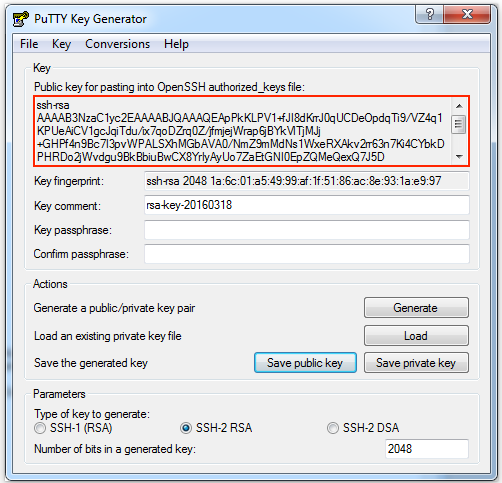
Visually Inspect Your Key Files
It is important to visually inspect you private and public key files to makesure that they are what you expect. OpenSSL will clearly explain the nature ofthe key block with a -----BEGIN RSA PRIVATE KEY----- or -----BEGIN PUBLIC KEY-----.
You can use less to inspect each of your two files in turn:
less private.pemto verify that it starts with a-----BEGIN RSA PRIVATE KEY-----less public.pemto verify that it starts with a-----BEGIN PUBLIC KEY-----
The next section shows a full example of what each key file should look like.
The Generated Key Files
The generated files are base64-encoded encryption keys in plain text format.If you select a password for your private key, its file will be encrypted withyour password. Be sure to remember this password or the key pair becomes useless.
The private.pem file looks something like this:
The public key, public.pem, file looks like:
Protecting Your Keys
Depending on the nature of the information you will protect, it’s important tokeep the private key backed up and secret. The public key can be distributedanywhere or embedded in your web application scripts, such as in your PHP,Ruby, or other scripts. Again, backup your keys!
Remember, if the key goes away the data encrypted to it is gone. Keeping aprinted copy of the key material in a sealed envelope in a bank safety depositbox is a good way to protect important keys against loss due to fire or harddrive failure.
Oh, and one last thing.
If you, dear reader, were planning any funny business with the private key that I have just published here. Know that they were made especially for this series of blog posts. I do not use them for anything else.
Found an issue?
Generate Rsa Key Windows
Rietta plans, develops, and maintains applications.
Learn more about our services or drop us your email and we'll e-mail you back.